
Think about the last time you dealt with healthcare paperwork. Now imagine doing that while managing a serious illness. For many patients and providers, this is the everyday reality: forms, e‑faxes, phone calls, and the waiting that follows.
Healthcare leaders know the stakes. Manual enrollment, benefit verification, and prior authorization create bottlenecks that delay care, frustrate providers, and erode trust. In a world where patients expect speed and clarity, operational agility isn’t a nice‑to‑have. It’s essential.
So, what does meaningful digital transformation look like in practice?
From Pain Points to Progress
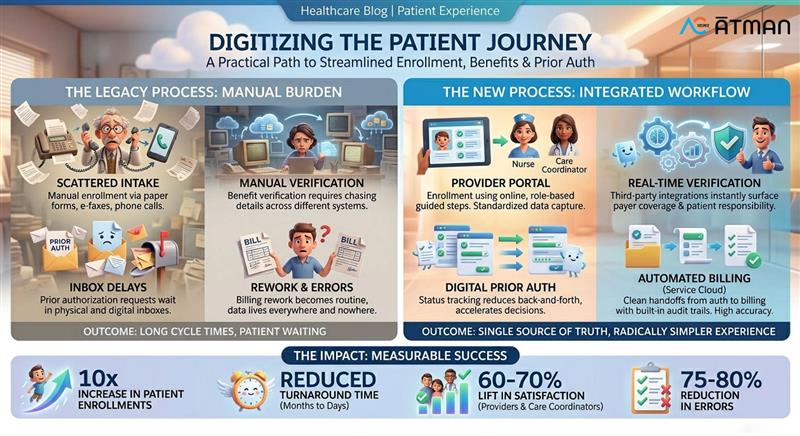
We often meet organizations that do a lot right: strong therapeutic portfolios, patient‑friendly websites, and committed care teams. Yet behind the scenes, the experience breaks down because the core processes are still manual. Enrollment happens on paper or e‑fax. Benefit verification requires chasing details across systems. Prior authorization sits in inboxes. Billing rework becomes routine. Data lives everywhere and nowhere.
The outcome is predictable: long cycle times, higher error rates, and patients waiting weeks (or months) to start treatment. Providers and care coordinators carry the administrative burden, while leaders struggle to see, measure, and improve the journey end‑to‑end.
The fix isn’t “more tools.” It’s an integrated, digital-first workflow anchored in a single source of truth and designed for adoption.
A Client Story: Reimagining the Patient Journey
One of our clients, a U.S.-based patient support organization serving individuals with serious illnesses, immune‑related conditions, and oncology asked a simple question: How do we make this easier for patients and providers, today?
Instead of point solutions, we partnered to redesign the end‑to‑end enrollment journey on Salesforce Health Cloud, creating a compliant, digitized flow from first touch to payment initiation. Here’s how it came together naturally, as part of the operating model:
Provider Portal (Experience Cloud):
Nurses and care coordinators enroll patients online using guided workflows. Paper and e‑fax are replaced with intuitive, role‑based steps and standardized data capture.
Real‑Time Benefit Verification:
Third‑party integrations surface payer coverage and patient responsibility instantly as no manual chasing, fewer surprises downstream.
Digital Prior Authorization: Auto‑populated forms and status tracking reduce back‑and‑forth, accelerate decisions, and keep stakeholders aligned.
Digital Claim Submission & Automated Billing (Service Cloud): Clean handoffs from authorization to billing with audit trails built in, improving accuracy and compliance.
Trust & Compliance (Salesforce Shield): Field audit trails, encryption, and policy enforcement ensure regulatory alignment from day one.
And because technology alone doesn’t change outcomes, we focused on adoption: role‑based training, process playbooks, and KPI dashboards to track enrollment velocity, authorization cycle time, and error rates.
The result? Fewer human touchpoints, centralized data, and a radically simpler experience for patients and care teams.
What Changed—In Practice
The shift felt different because it solved the everyday hurdles:
- Providers stopped toggling between e‑fax, phone, and email to enroll a single patient.
- Insurance details surfaced in real time, so benefit verification wasn’t a separate, manual task.
- Prior authorization moved from “inbox waiting” to transparent, trackable steps.
- Billing handoffs happened with clean data, reducing rework and stabilizing payment tracking.
- Under the hood, the platform became the single source of truth with secure, compliant data that leaders could trust and teams could act on.
Impact That Matters
The transformation wasn’t incremental—it was decisive:
- 10× increase in patient enrollments through a frictionless, digital-first intake.
- Turnaround time reduced from months to days, accelerating time‑to‑therapy.
- 60–70% lift in provider and care coordinator satisfaction, driven by clearer workflows and less administrative burden.
- 75–80% reduction in errors, thanks to automation, standardized forms, and centralized data.
- These outcomes do more than improve metrics. They give patients faster access to treatment and greater confidence throughout their journey. They also give leaders a foundation for continuous improvement: real‑time visibility, measurable KPIs, and a change-ready operating model.
What This Means for Healthcare Leaders
- Digital transformation isn’t about replacing people. It’s about removing friction so clinicians and coordinators can focus on care. The organizations that act now will set the standard for patient experience and operational resilience.
- If you’re starting (or restarting) this journey, aim for three things:
- Unified Workflow: One guided experience from enrollment to billing.No side‑channels, no hidden work.
- Data Integrity: A single source of truth with governance built in so compliance is a capability, not an afterthought.
- Adoption by Design: Training, playbooks, and KPIs that make the new way of working the easiest way to work.
Platform at a Glance
Salesforce Products Used: Health Cloud, Experience Cloud, Salesforce Shield, Service Cloud.
Ready to Move Fast—and Right?
If you’re looking to cut cycle times, reduce errors, and give patients a clearer path to therapy, we can help you design and deliver a digital enrollment journey that sticks technology, process, and adoption together.
About the Author

Swapnil Gulavani is a Salesforce Certified professional with over 10 years of experience designing scalable CRM solutions for enterprise clients across healthcare, finance, and manufacturing. With 8+ years in healthcare and 6+ Salesforce Health Cloud implementations, he has helped many organizations achieve tangible, compliant digital transformation.
Connect with Swapnil on LinkedIn.